Can Babies Eat Lobster?
Yes, from around 12 months, finely chopped. Lobster is safe for babies in principle, and it is a fine source of protein and B12. Three things keep the portion small: it is a major shellfish allergen, it is naturally salty before anyone adds anything, and the meat is firm enough to be a choking risk if it is not chopped properly.
Lobster is not an everyday baby food, and most people asking this question are at a holiday dinner wondering whether to share a bite. The answer is usually yes, with a couple of adjustments. The version on your plate, cooked in salted water and drowned in butter, is the problem rather than the lobster itself.
What is lobster?
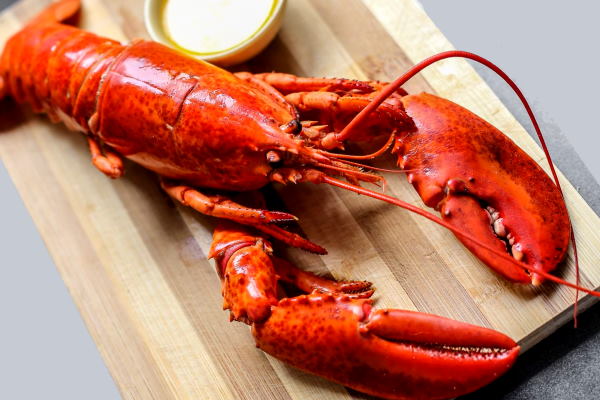
Lobsters are large marine crustaceans with hard shells and big claws, related to prawns, crab and crayfish. The meat comes mainly from the tail and claws, and it is firm, slightly sweet and much denser than fish. Because they live in seawater, their flesh carries sodium naturally, which is the bit people forget.
If your baby has already had prawns or shrimp without any trouble, that is reassuring for lobster, since crustaceans often cross-react as a group. It is not a guarantee, so still introduce it carefully.
Lobster nutrition
Lean and protein dense, with a sodium figure worth noting before you add anything.
| Nutrient | Per 100 g |
|---|---|
| Energy | 89 kcal |
| Protein | 19 g |
| Fat | 0.9 g |
| Salt | 0.5 g |
| Vitamin B12 | 1.4 mcg |
| Selenium | 41 mcg |
| Zinc | 2.5 mg |
Typical values for cooked lobster, before added salt or butter. Source: USDA FoodData Central.
When can babies eat lobster?
Shellfish can technically come in early, but lobster specifically is worth holding for a while:
Shellfish can be introduced from 6 months as an allergen. If you want to introduce crustaceans early, shrimp is easier to chop finely and lower in sodium than lobster.
The daily salt allowance rises to about 2 g, which leaves room for a small amount of lobster. Chop it very finely and skip the butter and salt entirely.
Once chewing is reliable, lobster can be served in normal pieces. Before that it stays finely chopped, because the meat is springy and firm, exactly like prawns.
Check for shell fragments: picking lobster meat from claws and knuckles reliably leaves small sharp pieces of shell behind. Run your fingers through every piece of meat before chopping. A shell fragment is a sharper problem than a fish bone.
Finely chopped lobster and potato mash
Potato dilutes the sodium and softens the texture, which solves both problems at once:
Finely chopped lobster and potato mash
Makes 2 baby portions, from 12 monthsIngredients
- 2 tablespoons cooked lobster meat, from the tail or claw
- 1 medium potato
- 1 tablespoon whole milk
- 1 teaspoon unsalted butter or olive oil
Method
- Check the lobster meat is cooked right through, with no translucent patches, and pick out any fragments of shell.
- Boil the potato until completely soft and mash it with the milk and butter.
- Chop the lobster meat extremely finely, almost to a paste for a younger baby.
- Fold the lobster through the mash until soft and moist, then cool before serving.
Risks and safety
Shellfish allergy is the main concern and it is one of the allergens most associated with severe, lifelong reactions. Introduce lobster on its own, earlier in the day, and watch for hives, rash, swelling of the lips or face, vomiting or an itchy mouth within two hours. Mussels are a separate allergy again. Wheezing, breathing difficulty, throat swelling or a pale floppy baby is anaphylaxis and needs emergency services immediately.
Then the practical points. Cook lobster fully, since undercooked shellfish carries vibrio and norovirus risk. Watch the sodium, especially if the lobster was boiled in seawater or salted water, and see our salt guide for daily limits. Chop finely for texture, check for shell, and skip the melted butter, which is where a surprising amount of the salt usually comes from.
Lobster FAQ
Can babies eat lobster?
Yes, from around 12 months for most families, though it can be introduced from 6 months as one of the common allergens. Cook it fully, chop it very finely and keep the portion small, since lobster is naturally high in sodium and is a major shellfish allergen.
Is lobster high in salt?
Yes, higher than most foods you would think of as unsalted. Lobster naturally contains around 0.4 to 0.6 g of salt per 100 g before anything is added, and restaurant lobster is usually cooked in heavily salted water and served with butter. For a baby under one, whose entire daily limit is 1 g, that matters.
Can a baby be allergic to lobster but not fish?
Yes. Shellfish allergy and finned fish allergy are completely separate. A baby who eats salmon happily can still react to lobster. Within shellfish, crustaceans like lobster, crab and prawns often cross-react with each other, while molluscs like mussels are a somewhat different group.
How should lobster be prepared for a baby?
Use meat from the tail and claws, cooked until fully opaque and white, with no translucent patches. Chop it very finely, since lobster is firm and springy and does not break down easily without molars. Skip the butter and salt, and mix it into something soft like potato mash.
Sources
- Lobster, Wikipedia.
- Feeding and Nutrition, American Academy of Pediatrics.
- FoodData Central, U.S. Department of Agriculture.
This article is general information, not medical advice. Every baby is different. Talk to your doctor, health visitor or paediatrician about your own baby, and about starting solids or any allergy concerns.