Can Babies Eat Nuts?
Yes, but the form is everything. Smooth nut butter thinned to a loose consistency, or finely ground nuts stirred into food, work from around 6 months, and introducing them early may actually reduce the chance of an allergy. Whole nuts are a different matter and stay off the menu until about 4 years, because they are one of the worst choking hazards there is.
Nuts are the food where the advice reversed inside a generation, so if your mother tells you to wait until three, she is repeating what she was correctly told at the time. The evidence now points the other way: introducing nuts early, in a safe form, is associated with fewer allergies rather than more. The catch is that "safe form" is doing a lot of work in that sentence.
What counts as a nut?
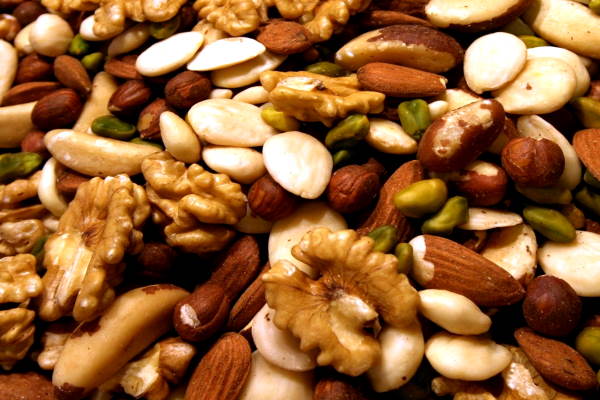
Two groups get lumped together. Tree nuts include almonds, walnuts, cashews, hazelnuts, pistachios, pecans, Brazil nuts and macadamias. Peanuts are not really nuts at all, they are legumes that grow underground, more closely related to peas and lentils. Both groups are major allergens and both are treated the same way when you introduce them.
We have separate pages with the same safety pattern for peanuts and almonds, if you want the detail on one particular nut.
Nut nutrition for babies
Nuts are dense in the good kind of fat, plus protein, fibre and vitamin E. Babies eat them in small amounts as thinned butter, so treat these as reference values rather than a portion.
| Nutrient | Per 100 g (mixed nuts) |
|---|---|
| Energy | 607 kcal |
| Fat | 54 g |
| of which unsaturated | 46 g |
| Protein | 20 g |
| Fibre | 7 g |
| Vitamin E | 7 mg |
| Magnesium | 230 mg |
Typical values for mixed tree nuts. Source: USDA FoodData Central.
When can babies eat nuts?
The age depends entirely on the form, which is why one number does not cover it:
Stir half a teaspoon of smooth nut butter into warm water, milk, oatmeal or fruit puree until it is loose and easily spooned. Introduce one nut type at a time.
Nuts blitzed to a flour and mixed into porridge, yogurt or baking. Ground means powder, not chopped, since even small fragments carry a choking risk.
Spread thinly rather than in thick blobs, since a mouthful of stiff nut butter can be hard to clear. Almond flour in pancakes and muffins is fine too.
Once molars are in and they chew reliably. Until then, whole and chopped nuts stay out of reach, including in cereals, cakes and snack mixes.
Talk to your doctor first if: your baby has severe eczema, an existing egg allergy, or a sibling with a nut allergy. These babies are at higher risk, and the usual advice is still to introduce nuts, but with medical guidance and sometimes a supervised first taste rather than at home alone.
How to serve nuts safely
The rule is simple: it should be smooth and spoonable, never lumpy, never a stiff spoonful on its own:
Do
Do not
- Give whole or chopped nuts before about 4 years
- Offer thick nut butter straight from the jar or on a spoon alone
- Use crunchy or chunky butters, which contain nut pieces
- Introduce two new nuts on the same day
- Try a first taste when your baby is unwell or before bed
Risks and safety
Two risks, and they need different responses. Choking is mechanical and entirely preventable by controlling the form: no whole nuts, no fragments, nothing stiff. Allergy is the other, and nuts are among the most common triggers of severe reactions in children.
Mild signs are hives, a blotchy rash, swelling around the lips or eyes, vomiting or an itchy mouth, usually within two hours. Stop, and speak to your doctor before offering that nut again. Wheezing, difficulty breathing, swelling of the tongue or throat, or a baby who goes pale and floppy is anaphylaxis. Call emergency services immediately. The American Academy of Pediatrics has current guidance on early introduction of allergens.
Once introduced, keep going: if your baby tolerates a nut, offering it regularly, roughly a couple of times a week, appears to help maintain that tolerance. A long gap after a successful introduction is not ideal.
Nuts FAQ
Can babies eat nuts?
Yes, in the right form. Smooth nut butter thinned with water, milk or puree, or finely ground nuts stirred into food, are suitable from around 6 months. Whole nuts and large pieces are a choking hazard and should wait until about 4 years.
Should I delay nuts to avoid an allergy?
No, and this is the part that changed. Current guidance is to introduce peanut and tree nuts from around 6 months, alongside other solids, because delaying appears to raise the risk of allergy rather than lower it. If your baby has severe eczema or an egg allergy, speak to your doctor before you start.
How do I introduce nuts safely?
Offer a small amount of smooth, thinned nut butter at home, earlier in the day, when your baby is well and you can watch them for a couple of hours. Start with one type of nut at a time and wait a few days before adding another, so you know what caused any reaction.
What are the signs of a nut allergy in a baby?
Usually within minutes to two hours: hives or a red blotchy rash, swelling of the lips, face or eyes, vomiting, or an itchy mouth. Difficulty breathing, wheezing, a swollen tongue or throat, or a baby who goes floppy or pale is anaphylaxis and needs emergency help immediately.
Sources
- Nut (fruit), Wikipedia.
- Feeding and Nutrition, American Academy of Pediatrics.
- FoodData Central, U.S. Department of Agriculture.
This article is general information, not medical advice. Every baby is different. Talk to your doctor, health visitor or paediatrician about your own baby, and about starting solids or any allergy concerns.