Can Babies Eat Haggis?
A small amount from 12 months, no more than once a week. Two separate limits stack here. Haggis is salty, which rules it out in the first year. And it contains liver, so the vitamin A restriction that applies to all offal applies here too. Neither makes it off limits, they just make it a small occasional portion rather than a plateful.
Haggis usually comes up once a year, around Burns Night, when a family wants to know whether the baby can share. The answer is a qualified yes after their first birthday, and the qualification is more interesting than most: it is not really about the offal being unappealing, it is about vitamin A, which is one of the few nutrients where more is genuinely worse.
What is haggis?
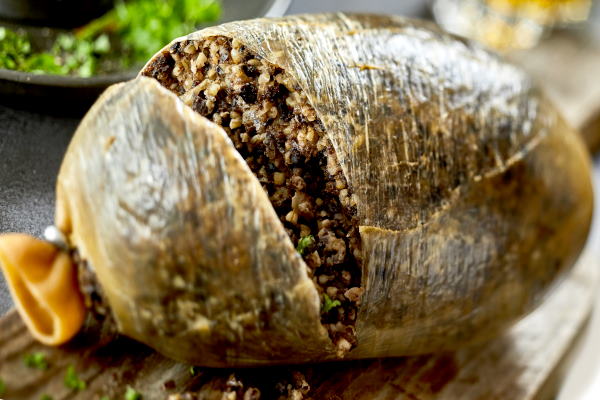
Haggis is a Scottish dish of sheep offal, traditionally heart, liver and lungs, minced with oatmeal, onion, suet and spices, then encased and simmered. The oatmeal makes it more of a savoury pudding than a meat dish. Vegetarian versions substitute pulses, vegetables and nuts for the offal.
Our liver page covers the vitamin A question in full, and it applies directly here.
Why vitamin A needs a limit
Most vitamins are water soluble and excess is simply passed out. Vitamin A is not. It is fat soluble, stored in the liver, and builds up over time. The preformed vitamin A in animal liver is far more concentrated than the beta carotene in vegetables, which the body converts only as needed and which carries no such risk.
| Nutrient | Per 100 g haggis |
|---|---|
| Energy | 280 kcal |
| Protein | 11 g |
| Fat | 20 g |
| Iron | 3.5 mg |
| Vitamin B12 | Around 4 mcg |
| Salt | 1.5 to 2 g |
| Vitamin A | High, from liver content |
Values vary considerably by recipe and producer. Check the label on shop bought haggis. Source: USDA FoodData Central.
When can babies have haggis?
Two limits running at once, salt and vitamin A:
The salt content alone makes it a poor fit against a daily limit of under 1 g. If you want your baby to have offal at this age, a small amount of plain cooked liver mashed into vegetables is easier to control.
Mashed through neeps and tatties, which dilutes both the salt and the richness. Once a week is the ceiling because of the liver.
Still counted against the weekly offal limit, and still watched for salt. Vegetarian haggis removes the vitamin A question, though not the salt. Venison gives you the same iron without the offal.
Count all liver together: the once a week limit covers everything containing liver, so haggis, liver pate, black pudding and a portion of liver and onions all draw on the same allowance. If your baby had pate earlier in the week, skip the haggis. Excess vitamin A over time can affect bones and the liver itself.
How to serve it
Dilution is the practical approach for both the salt and the strong flavour:
Do
- Mash a spoonful through plenty of unsalted potato and swede
- Check it is piping hot right through, then cool before serving
- Count it against the weekly offal allowance
- Consider vegetarian haggis, which has no liver
- Read the salt figure on the packet
Do not
- Serve it more than once a week
- Give it as a main portion rather than a spoonful
- Add salt to the neeps and tatties
- Give it alongside pate or black pudding in the same week
- Serve it to a baby under 12 months
Risks and safety
Vitamin A is the distinctive issue and the reason for the weekly limit, as above. Salt is the everyday one, and our salt guide puts the numbers in context. Neither is a reason to avoid haggis altogether, and the iron and B12 it provides are genuinely useful.
Two practical points. Haggis contains oats and often wheat in the casing or as a binder, so it involves gluten. And it is a dense, fatty food that some babies find heavy, so a small portion mashed through vegetables goes down better than a lump on its own. Reheat it thoroughly, since it is usually bought pre-cooked and reheated, and serve it warm rather than hot.
Haggis FAQ
Can babies eat haggis?
A small amount from around 12 months. Haggis is salty, which is the first limit, and it contains liver, which brings the vitamin A restriction that applies to all offal. Treat it as an occasional food, no more than once a week, rather than a regular meal.
Why does the liver in haggis matter?
Liver is extremely high in vitamin A, and unlike most vitamins, vitamin A accumulates in the body and can build up to harmful levels. Standard advice is to limit liver and liver products to once a week at most. Haggis contains sheep liver, so it falls under the same rule.
Is haggis too salty for a baby?
It is on the salty side, typically around 1.5 to 2 g of salt per 100 g. A baby under 12 months is limited to less than 1 g a day in total, and a toddler about 2 g, so a small spoonful is the sensible portion rather than a plateful.
Is vegetarian haggis suitable for babies?
It is often a better choice, since it contains no liver and so carries no vitamin A limit. It is usually made from oats, pulses, vegetables and spices. Check the salt on the label though, since vegetarian versions are frequently just as salty as the traditional kind.
Sources
- Haggis, Wikipedia.
- Salt in your diet, NHS.
- FoodData Central, U.S. Department of Agriculture.
This article is general information, not medical advice. Every baby is different. Talk to your doctor, health visitor or paediatrician about your own baby, and about starting solids or any allergy concerns.