Can Babies Eat Veggie Straws?
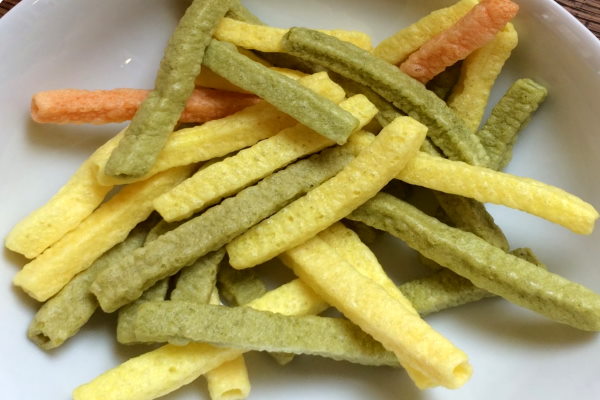
After 12 months, and think of them as crisps. Veggie straws are marketed in a way that suggests they are a vegetable snack. In practice they are potato starch and oil with a little vegetable powder for colour, plus salt. That does not make them harmful, it makes them a crisp with better branding, and worth treating accordingly.
This page is less about safety than about expectations. Plenty of parents reach for veggie straws precisely because they seem like a way to get vegetables into a reluctant toddler, and that is the part worth correcting. As an occasional snack they are unremarkable. As a vegetable strategy they do not work, and knowing that changes what else you offer.
What is actually in them
The typical ingredients list starts with potato starch and potato flour, followed by oil, then vegetable powders such as spinach, tomato or beetroot, then salt. The vegetable powders are present in small quantities and their main job is to produce the three colours that make the bag look like a vegetable product.
Our vegetables section has the real thing, and most of it works from six months.
Against actual vegetables
The comparison is stark once you put the numbers side by side:
| Per 30 g serving | Veggie straws | Steamed carrot sticks |
|---|---|---|
| Energy | Around 140 kcal | 10 kcal |
| Fat | 7 g | 0.1 g |
| Fibre | 0.6 g | 0.9 g |
| Salt | 0.3 to 0.5 g | Trace |
| Vitamin A | Negligible | 250 mcg |
| Counts as a vegetable portion | No | Yes |
Approximate values, which vary by brand. Check the packet for salt in particular. Source: USDA FoodData Central.
When can children have them?
Later than the packaging suggests, mostly because of texture:
Salt is the first reason, with a daily limit under 1 g. The hard brittle texture is the second. Puffed baby snacks that dissolve are the appropriate equivalent at this age.
Fine now and then as a snack, broken into shorter pieces and eaten sitting down. Count the salt against the rest of the day.
No reason to ban them, and no reason to feel they are covering a vegetable portion. Serve real vegetables alongside rather than instead.
They do not dissolve like baby puffs: this is the practical difference that matters. Puffed corn and rice snacks made for babies break down the moment they meet saliva. Veggie straws stay hard and snap into sharp fragments, which behave much more like a crisp. Do not treat them as an equivalent product just because both come in a bag.
Snacks that do the same job better
All of these are genuinely useful rather than merely harmless:
Puffed baby snacks
Designed to dissolve in the mouth, which makes them the right texture for a baby learning to self feed.
Steamed vegetable sticks
Carrot or courgette batons cooked soft, which give the same holding and dipping experience.
Toast fingers
Toast strips with a thin spread are cheap, quick and easy to hold.
Roasted vegetable strips
Home roasted sweet potato or squash strips, soft inside, with real vegetable content.
Risks and safety
Nothing here is dangerous in the way a whole grape or a nut is, but the texture deserves respect. Hard, brittle snacks break into pieces with sharp edges rather than softening, and they are eaten quickly and often on the move, which is the pattern most associated with choking incidents. Keep children seated, supervise, and snap the straws shorter for a young toddler.
Salt is the other everyday point, and our salt guide gives the age limits. Some brands also contain milk or soy derivatives in the seasoning, so check the label if allergens are a concern. The wider point stands: these are a snack food, and treating them as a vegetable serving means a child ends up eating fewer actual vegetables, which is the only real harm on offer here.
Veggie straws FAQ
Can babies eat veggie straws?
Best left until after 12 months, and even then treat them as a crisp rather than a vegetable. Veggie straws are mostly potato starch and oil, with small amounts of vegetable powder used largely for colour. They are also salty and hard, which is a poor combination for a young child.
Do veggie straws count as a vegetable?
No. The vegetable content is usually spinach, tomato or beetroot powder present in small quantities, mainly to colour the three shades in the bag. A serving does not provide anything close to a portion of vegetables, and the fibre and vitamin content is far below actual vegetables.
Are veggie straws a choking hazard?
They need care. They are hard and brittle rather than dissolving in the mouth, and they break into sharp fragments. That is a different profile from puffed baby snacks, which melt on contact with saliva. For a young child, snap them into smaller pieces and always supervise.
What snacks are better for a baby?
Puffed corn or rice snacks made for babies dissolve in the mouth and are far safer. Beyond that, soft fruit, steamed vegetable sticks, toast fingers, cubes of cheese or plain yogurt all make good snacks and actually contribute something. Homemade roasted vegetable strips give the same finger food appeal.
Sources
- Snack, Wikipedia.
- Choking Prevention, American Academy of Pediatrics.
- FoodData Central, U.S. Department of Agriculture.
This article is general information, not medical advice. Every baby is different. Talk to your doctor, health visitor or paediatrician about your own baby, and about starting solids or any allergy concerns.