Can Babies Eat Falafel?
Homemade and baked, from around 9 months. Shop bought, later. Chickpeas are a genuinely good food for babies, so the ingredient is not the issue. The problem is the format: deep fried, salted, and with a dry crumbly middle that a baby struggles to clear. Baked flat patties solve all three at once.
Falafel is a good example of a food where the base ingredient and the finished dish deserve different answers. Chickpeas mashed into a patty are close to ideal for a baby: plant protein, iron, fibre, and a mild flavour most children accept. Drop that same mixture into a fryer and salt it, and you have something rather less suitable.
What is falafel?
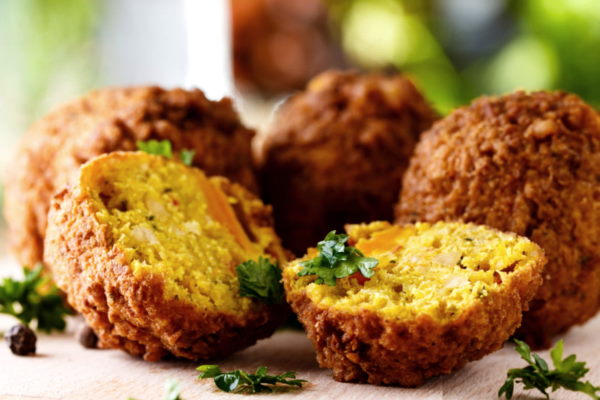
Falafel is a Middle Eastern fritter made from ground chickpeas or broad beans, mixed with herbs, garlic and spices, shaped into balls and deep fried. Traditional recipes use dried chickpeas soaked overnight but never cooked, which is what produces the characteristic crumbly interior. It is usually served in flatbread with tahini sauce.
Our hummus page covers the other chickpea staple, which works from six months and is easier for a young baby than falafel.
Baked against fried
Same mixture, and the cooking method does most of the work:
| Per 100 g | Baked, no salt | Deep fried, shop bought |
|---|---|---|
| Energy | 170 kcal | 333 kcal |
| Fat | 6 g | 18 g |
| Protein | 8 g | 13 g |
| Fibre | 6 g | 5 g |
| Iron | 2.5 mg | 3.4 mg |
| Salt | Trace | 1.4 g |
Approximate values. Shop bought falafel varies considerably in salt content. Source: USDA FoodData Central.
When can babies eat falafel?
Later than most chickpea foods, purely because of the texture:
Smooth hummus gives the same chickpeas in a form a young baby can actually manage. Falafel texture is too dry at this stage.
Flattened patties rather than balls, baked rather than fried, and served alongside something moist like yogurt or a vegetable mash.
Once the salt allowance rises, a shop bought falafel broken up into pieces is workable. Never serve a whole ball to a young child.
Never give a whole falafel ball: the round shape is close to the width of a young child's airway, and the interior is dry enough that it does not break down easily if inhaled. Flatten it into a patty, cut it into strips, or crumble it through other food. Serving it with something moist alongside also helps a great deal.
Baked baby falafel patties
Tinned chickpeas give a softer result than traditional falafel, which suits a baby better:
Baked baby falafel patties
Makes about 10 small patties, from 9 monthsIngredients
- 400 g tin chickpeas, no added salt, drained
- 2 tablespoons chopped fresh parsley
- 1 clove garlic, crushed
- 1 teaspoon ground cumin
- 2 tablespoons flour
- 1 tablespoon olive oil
Method
- Heat the oven to 200 C and line a baking tray.
- Blitz the chickpeas, parsley, garlic and cumin to a coarse paste, then stir in the flour.
- Shape into small flattened patties rather than balls, and brush both sides with olive oil.
- Bake for 20 to 25 minutes, turning halfway, until firm outside and soft inside, then cool before serving.
Risks and safety
Choking is the main concern and it is entirely about presentation, as above. Chickpea allergy is uncommon, though legume allergies do occur, so introduce it on its own if chickpeas are new. The tahini sauce almost always served alongside contains sesame, which is a major allergen, and the flatbread contains wheat, so a falafel wrap is a poor place to meet either for the first time.
Salt is the other everyday point. Shop bought and restaurant falafel is generally well salted, and the pickles and sauces served with it add more, so a baby's portion is better made at home. Our salt guide has the age limits, and flour covers why the raw mixture should not be tasted before baking.
Falafel FAQ
Can babies eat falafel?
Homemade baked falafel from around 9 months, crumbled or cut into strips. The chickpeas underneath are excellent for babies, providing protein, iron and fibre. What makes shop bought falafel unsuitable is the deep frying, the salt, and a firm crumbly texture that is hard for a baby to manage.
Why is falafel a choking risk?
Because of the texture rather than the size. Falafel has a firm crust and a dense, dry, crumbly middle that does not soften much with saliva. A whole ball is also roughly the wrong shape for a small airway. Serving it as flattened patties or crumbled through other food removes most of that.
Does falafel contain allergens?
Chickpeas are legumes and rarely cause allergy, though it happens. The bigger consideration is what falafel is usually served with: tahini sauce contains sesame, a major allergen, and flatbread contains wheat. Falafel mixes sometimes contain sesame seeds in the coating too, so check.
Can I use tinned chickpeas to make falafel?
For a baked version, yes, though the texture will be softer and more like a patty than traditional falafel. Classic falafel uses dried chickpeas soaked overnight and never cooked before frying, which is what gives the crumbly interior. For a baby, the softer tinned version is actually easier to eat.
Sources
- Falafel, Wikipedia.
- Choking Prevention, American Academy of Pediatrics.
- FoodData Central, U.S. Department of Agriculture.
This article is general information, not medical advice. Every baby is different. Talk to your doctor, health visitor or paediatrician about your own baby, and about starting solids or any allergy concerns.