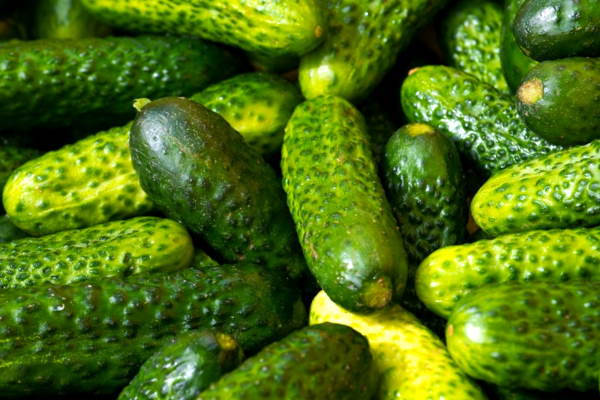
Can Babies Eat Pickles?
Not before 12 months, and only a small piece after that. There is nothing harmful in a pickle, it is a cucumber. The issue is that it has spent weeks absorbing salt brine, and one medium pickle can carry close to an entire day's salt allowance for a baby. Plain cucumber gives you the same crunch with none of it.
Pickles come up mostly because a toddler has spotted one on someone's plate and wants it. They are not dangerous, and a lick of a pickle is not going to do harm. But they are one of the saltiest things in an average fridge, and unlike bread or cheese, they bring nothing else along with the salt to justify it.
What are pickles?
Pickles are vegetables, usually cucumbers, preserved either in a salt and vinegar solution or by natural fermentation in salt brine. Vinegar pickles are the common shop bought kind, preserved by acidity. Fermented pickles are preserved by lactic acid bacteria, which produces live cultures but uses just as much salt.
If it is the sour, fermented angle you are after, kimchi has the same salt problem, while yogurt and kefir deliver live cultures without it.
Pickle versus cucumber
Same vegetable, transformed by the brine:
| Per 100 g | Dill pickle | Fresh cucumber |
|---|---|---|
| Energy | 12 kcal | 15 kcal |
| Salt | 2.9 g | Trace |
| Carbohydrate | 2.3 g | 3.6 g |
| Fibre | 1.2 g | 0.5 g |
| Vitamin K | 50 mcg | 16 mcg |
| Water | 94 g | 95 g |
Typical values. A medium pickle weighs about 35 g, giving roughly 0.9 g of salt. Source: USDA FoodData Central.
When can babies eat pickles?
Governed entirely by the daily salt allowance:
With a limit of under 1 g of salt for the whole day, a pickle does not fit. Offer strips of fresh cucumber instead, which babies enjoy just as much, especially when teething.
The allowance rises to about 2 g a day, so a thin strip is workable now and then. Cut lengthways rather than into coins.
Fine as part of a meal. Just count it against everything else salty that day, since bread, cheese and ham add up quickly.
Never use pickle juice as a remedy: pickle brine occasionally gets recommended online for cramps, hydration or hiccups. It is essentially concentrated salt water, and giving it to a baby or young child is genuinely dangerous. If your child needs rehydrating, use water, milk or an oral rehydration solution from a pharmacy.
Better ways to get the same thing
Most of what a toddler likes about a pickle is the crunch and the sourness, both of which are available elsewhere:
Cucumber strips
Cold from the fridge, they are soothing on sore gums and have no salt at all. Peel for a younger baby.
A squeeze of lemon
If it is sourness they like, a little lemon or lime through vegetables gives that without the brine.
Plain yogurt
Tangy and sour, and it brings protein, calcium and live cultures with it.
Quick soaked cucumber
Cucumber strips left ten minutes in a little vinegar and water taste pickled, with almost no salt.
Risks and safety
Salt is the substantive issue. A baby's kidneys cannot clear excess sodium efficiently, and a high salt diet strains them, pushes blood pressure up over time and builds a preference for salty food. One pickle will not cause harm, but pickles as a regular snack are a poor pattern. Our salt guide has the age by age limits.
Texture matters too. Pickles stay firm and do not soften in the mouth, and a thick round slice is close to the width of a young child's airway, so cut lengthways into thin strips. Finally, home pickled and home canned foods carry a small botulism risk if they were not prepared and acidified properly, which is a reason to stick to commercially produced jars for a young child.
Pickles FAQ
Can babies eat pickles?
Best left until after 12 months, and even then only a small piece. Pickles are preserved in salt brine, and one medium pickle can contain around 0.9 g of salt, which is close to a whole day's limit for a baby under one. The cucumber underneath is fine, the brine is the problem.
How much salt is in a pickle?
More than most people guess. A medium dill pickle carries roughly 0.9 to 1.2 g of salt. A baby under 12 months should have less than 1 g of salt in an entire day, and a toddler about 2 g, so a single pickle uses a large share of that in one go.
Are pickles a choking hazard?
They can be, because of the shape and firmness. A whole gherkin or a thick round slice is exactly the wrong size for a small airway, and pickles stay firm rather than softening in the mouth. Cut them into thin lengthways strips rather than coins, and only from around 12 months.
What about fermented pickles and gut health?
Naturally fermented pickles do contain live cultures, unlike vinegar pickles which are simply preserved in acid. The salt content is the same either way though, so they are not a good route to probiotics for a baby. Plain yogurt or kefir does that job with far less salt.
Sources
- Pickled cucumber, Wikipedia.
- Salt in your diet, NHS.
- FoodData Central, U.S. Department of Agriculture.
This article is general information, not medical advice. Every baby is different. Talk to your doctor, health visitor or paediatrician about your own baby, and about starting solids or any allergy concerns.