Can Babies Eat Kefir?
Plain full fat kefir from around 6 months, as a food rather than a drink. The rule that cow's milk waits until 12 months applies to milk as a main drink, not to dairy in food, which is why yogurt and kefir are fine earlier. Choose unsweetened, start small, and be aware that fermentation leaves a trace of alcohol behind.
Kefir has become the fermented food of the moment, and for babies it is a reasonable one. It behaves much like yogurt, it is easy to stir into things, and it carries a broader range of live cultures than most yogurts do, and far less sugar than a bottle of Yakult. Two details are worth knowing that rarely get mentioned: the milk timing rule, and the alcohol.
What is kefir?
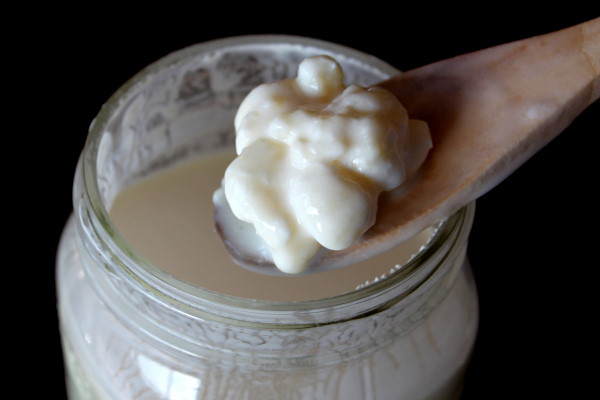
Kefir is milk fermented with kefir grains, a cluster of bacteria and yeasts that looks a little like cauliflower. The yeasts are what distinguish it from yogurt, and they are also why fermentation produces a small amount of alcohol and carbon dioxide alongside the lactic acid. The result is thinner and tangier than yogurt, and slightly fizzy.
Our yogurt page covers the more familiar option, and much of the advice is the same.
Kefir nutrition
Similar to milk, with the live cultures as the addition.
| Nutrient | Per 100 g, plain full fat |
|---|---|
| Energy | 61 kcal |
| Protein | 3.3 g |
| Fat | 3.3 g |
| Calcium | 120 mg |
| Vitamin B12 | 0.4 mcg |
| Sugars, natural lactose | 4 g |
| Alcohol | Around 0.5 percent |
Typical values for plain unsweetened kefir. Flavoured versions contain considerable added sugar. Source: USDA FoodData Central.
Serving kefir by age
The food and drink distinction is what governs the timeline:
Stirred into porridge, mashed fruit or a vegetable puree. Start with a teaspoon or two and build up, since fermented foods can cause wind if introduced quickly.
Works well as a base for fruit bowls or a dip. Still alongside breast milk or formula rather than replacing any of it.
Once cow's milk is suitable as a main drink, kefir can be drunk too. Plain and unsweetened, since flavoured versions carry a lot of added sugar.
Homemade kefir can be considerably stronger: the alcohol content rises with fermentation time and temperature, and a batch left for a couple of days at room temperature can reach several times the level of a shop bought bottle. For a baby, commercial kefir with a stated composition is the more predictable choice. Our alcohol page explains why babies are so sensitive.
Kefir and berry breakfast bowl
Ground oats thicken thin kefir into something easier for a baby to spoon:
Kefir and berry breakfast bowl
Makes 2 baby portions, from 6 monthsIngredients
- 4 tablespoons plain full fat kefir
- 2 tablespoons soft berries, mashed
- 1 tablespoon ground oats
- A pinch of cinnamon
Method
- Mash the berries thoroughly so no whole fruit remains.
- Stir the ground oats into the kefir and leave for two minutes to thicken slightly.
- Fold the mashed berries and cinnamon through.
- Serve straight away, starting with a small portion the first few times.
Risks and safety
Milk is one of the major allergens, so if your baby has not had dairy before, introduce it on its own and watch for a reaction. Kefir is not suitable for a baby with a diagnosed cow's milk allergy, and water kefir is a different product made without dairy. Quark is another fresh dairy food to introduce the same way.
Three practical points. Use pasteurised kefir, which commercial products are; unpasteurised dairy is not suitable for babies. Choose plain rather than flavoured, since fruit kefirs are often heavily sweetened and added sugar is not recommended under two, as our sugar guide explains. And go gradually with quantity, since a sudden large intake of fermented food can cause wind and loose stools in a baby who is not used to it.
Kefir FAQ
Can babies have kefir?
Plain full fat kefir can be given from around 6 months as a food, in the same way as yogurt, stirred into porridge or fruit. What waits until 12 months is cow's milk as a main drink, so kefir should not replace breast milk or formula. Choose unsweetened, and start with a small amount.
Does kefir contain alcohol?
A trace, yes. Fermentation produces small amounts of alcohol, typically around 0.5 percent in commercial kefir and sometimes higher in homemade versions left to ferment longer. That is a very small quantity in a spoonful, but it is a reason to choose shop bought over a long fermented homemade batch for a baby.
Is kefir better than yogurt for babies?
It contains a wider range of bacteria and yeasts than most yogurts, so it offers more variety in live cultures. Nutritionally they are similar, and yogurt is thicker, which is often easier for a young baby to eat. Both are good; there is no need to switch if yogurt is working.
How much kefir should a baby have?
Start with a teaspoon or two and build up gradually. Kefir is a fermented food and a large amount introduced suddenly can cause wind or loose stools. A few tablespoons a day is plenty for a baby, alongside their usual milk feeds rather than instead of them.
Sources
- Kefir, Wikipedia.
- Feeding and Nutrition, American Academy of Pediatrics.
- FoodData Central, U.S. Department of Agriculture.
This article is general information, not medical advice. Every baby is different. Talk to your doctor, health visitor or paediatrician about your own baby, and about starting solids or any allergy concerns.