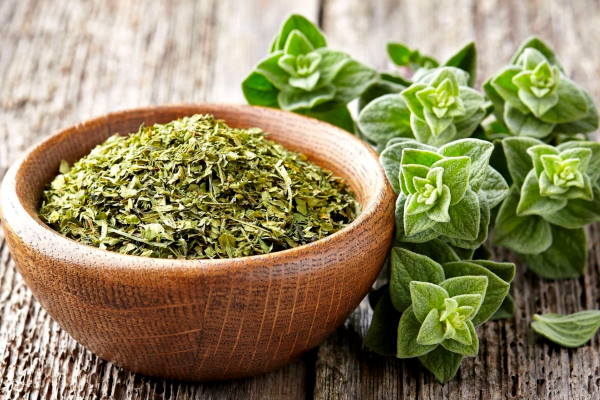
Can Babies Eat Oregano?
Yes, from 6 months, in cooking amounts. Oregano is a straightforward herb with no heat and no salt, and it makes tomato sauces, beans and roasted vegetables taste like a proper meal. The only thing to separate out is oregano oil, a concentrated supplement that has nothing to do with the jar in your cupboard and is not suitable for babies.
Oregano is the herb most likely to already be in the cupboard, and it is a good one to reach for when cooking for a baby. It is pungent enough to be noticed in a bland dish, it survives long cooking, and it costs nothing to add. The page exists mainly to draw a line between the herb and the supplement that shares its name.
What is oregano?
Oregano is a flowering plant in the mint family, native to the Mediterranean and western Asia. The leaves are used fresh or dried, and unusually among herbs it is often considered better dried, since drying concentrates the aromatic compounds. Greek and Italian oregano are the common culinary types, while Mexican oregano is a different plant with a similar flavour.
Our herbs page covers the wider set, and oregano is also a component of zaatar.
Oregano nutrition
The figures look impressive per 100 g, which is misleading, since a pinch weighs well under a gram.
| Nutrient | Per 100 g dried | Per pinch (0.3 g) |
|---|---|---|
| Energy | 265 kcal | 0.8 kcal |
| Fibre | 42 g | 0.13 g |
| Iron | 37 mg | 0.11 mg |
| Calcium | 1600 mg | 4.8 mg |
| Vitamin K | 622 mcg | 1.9 mcg |
| Salt | Trace | Trace |
Typical values for dried oregano. Herbs are a flavouring, not a nutrient source. Source: USDA FoodData Central.
Using oregano by age
Little changes with age, since the amounts are small throughout:
Into a tomato sauce, a lentil dish or over roasting vegetables. Add it early so it softens and infuses.
Fresh oregano can be stirred in at the end. Chop it small, since whole leaves can stick to the roof of the mouth.
No restriction. Oregano is a good herb to keep on a windowsill, since it survives neglect better than basil.
Oregano oil is a supplement, not a herb: it is sold in health shops and sometimes promoted for infections or gut health in children. It is enormously more concentrated than the dried leaf, can irritate the mouth and digestive tract, and its safety in infants has not been established. Essential oils generally should not be given to babies by mouth.
Oregano roasted vegetable fingers
Roasting concentrates the sweetness of the vegetables, and oregano gives it a savoury edge:
Oregano roasted vegetable fingers
Makes 3 baby portions, from 6 monthsIngredients
- 1 courgette, cut into finger sized batons
- 1 red pepper, cut into strips
- 1 tablespoon olive oil
- Half a teaspoon dried oregano
Method
- Heat the oven to 200 C and toss the vegetable batons with the olive oil and oregano.
- Spread them out on a tray so they roast rather than steam.
- Roast for 20 to 25 minutes, until completely soft and easily squashed between your fingers.
- Cool until just warm and serve as finger food.
Risks and safety
In cooking amounts oregano is about as low risk as an ingredient gets. Allergy is rare, and there is no heat, salt or sugar involved. Introduce it once on its own as you would any new food, and after that it needs no particular thought.
The two things worth remembering are texture and concentration. Dried oregano is fine stirred into food, but a large pinch sprinkled dry onto a baby's tongue is unpleasant and can make them cough, so cook it in rather than dusting it on. And keep the distinction between the herb and oregano essential oil firmly in mind, since the second is a supplement with a very different risk profile. Our herbs page covers that line in more detail.
Oregano FAQ
Can babies eat oregano?
Yes, from around 6 months, in the amounts used in cooking. A pinch of dried oregano in a tomato sauce, a bean dish or on roasted vegetables is fine and adds real flavour without salt. Introduce it on its own the first time, as with any new food.
Is oregano oil safe for babies?
No. Oregano oil is a concentrated essential oil sold as a supplement, and it is a completely different thing from the dried leaf in your cupboard. It is far too strong for an infant, can irritate the mouth and digestive tract, and has not been established as safe in babies. Do not give it.
Should I use fresh or dried oregano?
Dried works better for most baby cooking, because oregano is one of the few herbs that arguably improves when dried, and it stands up to long simmering. Use about a third as much dried as you would fresh, and add it early in cooking so it softens and releases its flavour.
Is oregano the same as marjoram?
They are closely related and often confused. Marjoram is sweeter and milder, oregano is more pungent and peppery. Both are fine for babies from 6 months in cooking amounts, and they can be substituted for each other, though you may want slightly less oregano than marjoram.
Sources
- Oregano, Wikipedia.
- Feeding and Nutrition, American Academy of Pediatrics.
- FoodData Central, U.S. Department of Agriculture.
This article is general information, not medical advice. Every baby is different. Talk to your doctor, health visitor or paediatrician about your own baby, and about starting solids or any allergy concerns.