Can Babies Eat Marmite?
A scrape only, and better after 12 months. Marmite is not harmful in itself, it is simply one of the saltiest things in a British kitchen. A baby under one is allowed less than a gram of salt a day in total, and a normally spread slice of Marmite toast blows through a big chunk of that. If you want to give it, go for the reduced salt jar and spread it like you resent it.
Marmite occupies a strange position in baby feeding. It is fortified with exactly the vitamins that vegetarian families worry about, and it is also saltier than seawater. Both things are true at once, which is why the answer is not a simple yes or no but a question of quantity. The good news is that a genuinely thin scrape is all anyone needs, because the flavour is not subtle.
What is Marmite?
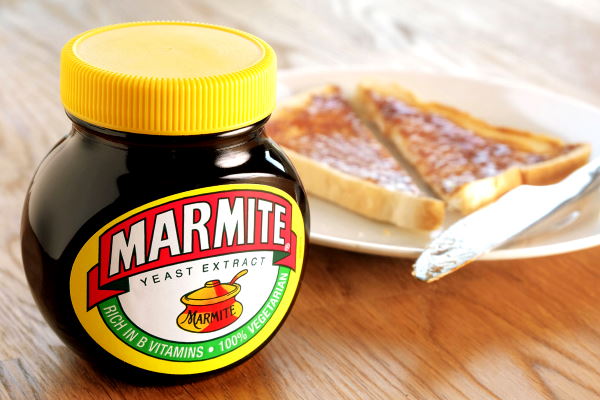
Marmite is a sticky, dark brown spread made from yeast extract, a by-product of beer brewing. It is intensely savoury, thanks to a high natural glutamate content, and it is fortified with B vitamins including thiamin, riboflavin, niacin, folic acid and B12. It has been made in Britain since 1902 and people continue to have strong opinions about it.
Australia's Vegemite is the closest relative, made the same way and with similar salt levels, though it tastes noticeably different. Everything on this page applies to both.
Marmite nutrition
Look at the salt line first, then the vitamins. Both are the reason this page exists.
| Nutrient | Per 100 g | Per 4 g scrape |
|---|---|---|
| Energy | 250 kcal | 10 kcal |
| Salt | 10.8 g | 0.43 g |
| Protein | 34 g | 1.4 g |
| Folic acid | 1250 mcg | 50 mcg |
| Vitamin B12 | 24 mcg | 1 mcg |
| Thiamin (B1) | 8 mg | 0.3 mg |
Typical values for standard Marmite. A 4 g scrape uses nearly half a baby's entire daily salt allowance. Source: USDA FoodData Central.
When can babies have Marmite?
The whole timeline is about salt tolerance rather than anything else:
With a daily limit under 1 g of salt, there is very little room. If you do offer it, make it a barely visible scrape of the reduced salt version and count it against everything else salty that day.
The limit rises to about 2 g of salt a day, so a genuinely thin spread on toast a few times a week fits. Reduced salt Marmite roughly halves the impact.
Spread it much thinner than you would for yourself: the usual mistake is spreading Marmite like butter. For a small child it should be a stain on the toast rather than a layer, and even then it is worth checking what else they have eaten that day. See our salt guide for the full daily limits.
The vitamin argument
The case for Marmite is real, particularly for families not eating meat. It is one of the few reliable plant based sources of B12, and the folic acid content is high. It is worth being clear about the arithmetic though.
Vitamin B12
A scrape supplies a useful share of a toddler's daily B12, which matters in vegan and vegetarian diets where sources are limited.
Folic acid
Marmite is fortified with folic acid, important for growth and for making red blood cells.
The catch
Getting a substantial vitamin dose means eating enough to break the salt limit. Treat the vitamins as a small bonus, not a strategy.
Risks and safety
Salt is the whole issue. A baby's kidneys cannot clear excess sodium efficiently, and a consistently high salt diet strains them, pushes blood pressure up over time, and builds a taste for salty food that is hard to shift. The NHS sets the under one limit at less than 1 g of salt a day.
Two smaller points. Standard Marmite contains barley, so it is not gluten free unless the jar says so. And a child who gets hold of the jar and eats a spoonful will probably be violently unimpressed by the taste long before the salt becomes a medical problem, though if a large amount does go down, offer water and speak to your doctor.
Marmite FAQ
Can babies eat Marmite?
Only in very small amounts, and it is better to wait until after 12 months. Marmite is extremely salty, around 10 g of salt per 100 g, and babies under a year should have less than 1 g of salt a day in total. A thin scrape on toast is the most it should ever be.
How much Marmite can a baby have?
A scrape so thin you can see the toast through it, no more than a few times a week. Spread the way most adults do it, a single slice could use a fifth of a toddler's entire daily salt allowance. The reduced salt version is a better choice for small children.
Is Marmite good for babies because of the B vitamins?
Marmite is genuinely rich in B vitamins, including B12 and folate, and the fortified version is a useful source for vegetarian and vegan families. The catch is that you would need more than is sensible on salt grounds to get a meaningful amount, so treat the vitamins as a bonus rather than a reason to serve it.
Does Marmite contain gluten?
Standard Marmite is made from brewer's yeast extract, a by-product of beer brewing, so it contains barley and is not gluten free. Some versions are certified gluten free, so check the label if that matters in your household.
Sources
- Marmite, Wikipedia.
- Salt in your diet, NHS.
- FoodData Central, U.S. Department of Agriculture.
This article is general information, not medical advice. Every baby is different. Talk to your doctor, health visitor or paediatrician about your own baby, and about starting solids or any allergy concerns.