Can Babies Eat Yakult?
Best left until after 24 months. The live bacteria in Yakult are real and the product is perfectly safe. The issue is what they come packaged with: about 10 g of sugar in a 65 ml bottle, which is a remarkable concentration for something that size. Plain yogurt or kefir delivers live cultures from 6 months with none of it.
Yakult is often bought with genuinely good intentions, usually after a run of tummy troubles or a course of antibiotics. The live bacteria are not the problem. The problem is that they arrive in a small sweet drink, and for a child under two the sugar outweighs any benefit that a spoon of plain yogurt could not also provide. Activia raises much the same question.
What is Yakult?
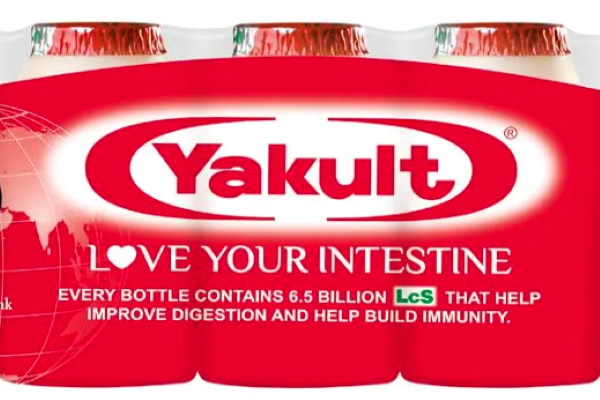
Yakult is a fermented milk drink containing a specific strain of Lactobacillus, developed in Japan in the 1930s. Skimmed milk is fermented with the bacteria and then sweetened, which is necessary because the fermented base is extremely sour. It is sold in small single serving bottles.
Our Activia page covers the other widely marketed probiotic product, and kefir the fermented option that suits babies best.
The sugar in context
The volume is small, which is exactly what makes the concentration surprising:
| Per serving | Yakult (65 ml) | Plain yogurt (100 g) |
|---|---|---|
| Energy | 50 kcal | 61 kcal |
| Total sugars | Around 10 g | 4.7 g, all lactose |
| Added sugar | Around 8 g | 0 g |
| Protein | 0.8 g | 3.5 g |
| Fat | Trace | 3.3 g |
| Live cultures | Yes | Yes |
Approximate values, which vary by market. Note the protein and fat rows, which matter for a growing baby. Source: USDA FoodData Central.
When can children have it?
Governed by the added sugar guidance rather than anything about the bacteria:
Added sugar has no place in the first year, and sweet drinks are particularly bad for new teeth. Plain yogurt or kefir gives live cultures from around 6 months.
The advice to avoid added sugars until two applies. A bottle at a family gathering is not a crisis, it just does not need to become a routine.
Fine now and then, ideally with a meal rather than sipped between meals, since frequency of sugar on teeth matters more than the total amount. The same reasoning applies to ice cream.
Sweet drinks are worse for teeth than sweet food: a drink coats the teeth and, if sipped slowly, keeps them bathed in sugar for a long stretch. That is why our sugar guide is firmer about drinks than about the same sugar eaten with a spoon. If a child does have Yakult, giving it with a meal and following with water is better than as a between meals treat.
If you want probiotics for a baby
There are better routes, and they double as actual food:
Plain full fat yogurt
Live cultures, protein, calcium and fat, with no added sugar. Suitable from around 6 months as a food.
Kefir
Kefir carries a wider range of cultures than most yogurts and works the same way in a bowl.
Infant probiotic drops
If a doctor has recommended probiotics specifically, drops formulated for infants avoid the sugar entirely.
Risks and safety
Yakult is not a risky product. It contains milk, which is a major allergen, and it is pasteurised before the culture is added, so there is no food safety concern, unlike unpasteurised cheese. Nothing here is dangerous. Kefir gives you the same cultures without the sugar.
The reason for the 24 month line is sugar, and specifically sugar in liquid form landing on teeth that have recently come through. On the probiotic side, it is worth being clear that evidence for probiotics in healthy children is mixed and strain specific, so a general assumption of benefit is not well founded. If your baby has persistent digestive symptoms, or has just finished antibiotics and you are wondering what would help, that is worth asking your doctor or health visitor rather than solving from the supermarket chiller.
Yakult FAQ
Can babies drink Yakult?
Best left until after 24 months. Yakult is a fermented milk drink containing live bacteria, but a standard 65 ml bottle carries around 10 g of sugar, which is close to two and a half teaspoons in a very small volume. Added sugar is not recommended under two, and that is the deciding factor.
Does Yakult help a baby's digestion?
It contains a specific live bacterial strain, and probiotics have been studied for various digestive issues in children with mixed results. Whether it helps your particular baby is not something a bottle of sweetened drink can answer. If your baby has ongoing digestive problems, that is a conversation with your doctor.
Is there a sugar free version?
Yakult produce a light version with less sugar, sweetened partly with artificial sweeteners. That solves the sugar issue but introduces sweeteners, which are also not recommended for young children. Plain unsweetened yogurt or kefir gives live cultures without either.
What is a better source of probiotics for a baby?
Plain full fat yogurt or kefir, both of which can be given from around 6 months as a food. They carry live cultures, no added sugar, and useful protein, calcium and fat. They also come in a form a baby can eat with a spoon rather than a drink, which is better for teeth.
Sources
- Yakult, Wikipedia.
- Foods and Drinks for 6 to 24 Month Olds, Centers for Disease Control and Prevention.
- FoodData Central, U.S. Department of Agriculture.
This article is general information, not medical advice. Every baby is different. Talk to your doctor, health visitor or paediatrician about your own baby, and about starting solids or any allergy concerns.