Can Babies Eat Toast?
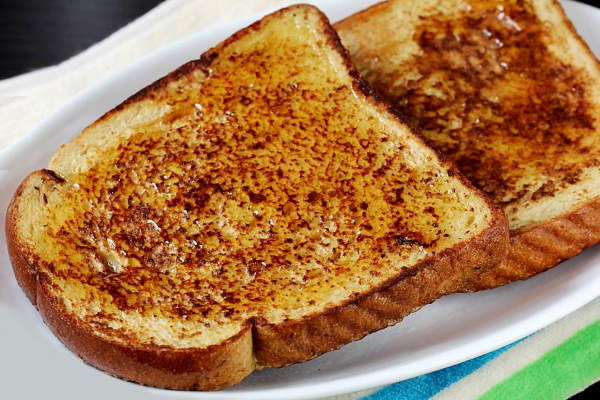
Yes, from 6 months, and toast fingers are a brilliant first food. Toast is easier for a baby to handle than fresh bread, which goes gummy and can ball up in the mouth. Two things to get right: toast it lightly rather than to a crisp, and keep an eye on salt, because bread contributes more of it than almost anything else in a small child's day.
Toast fingers are the food most baby led weaning guides start with, and the reason is mechanical rather than nutritional. A six month old cannot yet pick up small things, but they can grab a strip in their fist and gnaw the end. Toast holds its shape long enough for that to work, then dissolves. Fresh bread does the opposite, turning into a paste that sticks to the roof of the mouth.
Why toast beats fresh bread
Toasting drives moisture out and firms the structure. That means a strip stays rigid enough to hold, and it breaks down into soft crumbs rather than compressing into a gummy lump. Fresh white bread in particular can form a dense ball that a baby struggles to clear, which is why most guidance suggests toasting or lightly drying bread first.
Our bread page covers loaves in general, including which types are lowest in salt.
What is in a slice
The salt row is the one that matters here, and it varies a lot between loaves.
| Nutrient | Per slice (about 36 g) |
|---|---|
| Energy | 93 kcal |
| Carbohydrate | 17 g |
| Protein | 3.6 g |
| Fibre | 1.5 g |
| Salt | 0.4 g |
| Iron | 1 mg |
| Calcium | 50 mg |
Typical values for a slice of wholemeal bread. Under 12 months the total daily salt limit is 1 g. Source: USDA FoodData Central.
Cutting toast by age
The shape changes as their grip develops, which is the main thing that shifts:
Two fingers wide and long enough to stick out of a fist. At this stage a baby grips with their whole hand, so a strip they can gnaw the end of works best.
Once the pincer grip arrives, bite sized squares become manageable and are good practice for picking things up precisely.
Do not over toast it: hard, brittle, dark toast breaks into sharp fragments that are difficult for a baby to manage and can scratch. You want it firm and dry, still pale gold, giving slightly if you press it. Cut the crusts off for a young baby if they are especially tough.
What to put on top
Thin layers, spread to the edges, rather than a thick blob in the middle:
Good toppings
Avocado toast fingers
The simplest complete baby breakfast there is, and it takes three minutes:
Avocado toast fingers
Makes 1 baby portion, from 6 monthsIngredients
- 1 slice of low salt bread
- Quarter of a ripe avocado
- A squeeze of lemon
- A pinch of paprika, optional
Method
- Toast the bread lightly, so it is firm but not crunchy or brittle.
- Mash the avocado with the lemon until completely smooth.
- Spread it thinly over the toast, right to the edges, rather than in a thick layer.
- Cut into finger width strips and serve while still soft.
Risks and safety
Wheat is one of the major allergens, so if your baby has not had it before, introduce toast on its own and watch for a reaction. Introducing gluten containing foods from around six months, rather than delaying, is current guidance.
Salt is the ongoing issue rather than an acute one. Bread is mild tasting but salty, and it is eaten daily, which is what makes it add up. Look for lower salt loaves, and see our salt guide for the age limits. On texture, always supervise, keep your baby sitting upright, and remember that gagging is noisy and normal while choking is silent, so a coughing baby who is going red is usually sorting it out themselves.
Toast FAQ
Can babies eat toast?
Yes, from around 6 months. Toast cut into finger sized strips is one of the best first self feeding foods, because a baby can grip it and it softens in the mouth rather than breaking into hard crumbs. Toast it lightly, so it holds together without being crunchy.
Is bread too salty for babies?
It is the single biggest source of salt in many children's diets, which surprises people because bread does not taste salty. A typical slice contains around 0.4 g of salt, and a baby under one is limited to less than 1 g a day in total. One slice is fine, but count it against the rest of the day.
How should toast be cut for a baby?
Into strips about the width of two adult fingers, long enough that a bit sticks out of a closed fist. Small squares are harder for a young baby to pick up and easier to stuff in whole. From about 9 months, when the pincer grip develops, smaller pieces become manageable.
What can I put on a baby's toast?
Mashed avocado, smooth fruit puree, cream cheese, hummus or a thin scrape of smooth nut butter. Spread thinly rather than in blobs, since a thick layer of anything sticky can be hard to clear from the mouth. Skip butter with salt, jam and yeast extract spreads early on.
Sources
- Toast (food), Wikipedia.
- Salt in your diet, NHS.
- FoodData Central, U.S. Department of Agriculture.
This article is general information, not medical advice. Every baby is different. Talk to your doctor, health visitor or paediatrician about your own baby, and about starting solids or any allergy concerns.