Can Babies Eat Jaggery?
Best left until after 24 months. Jaggery has a reputation as the healthy sugar, and it does keep minerals that refining removes. But it is still roughly three quarters sugar, and the recommendation to avoid added sugars before two applies to it exactly as it does to white sugar, honey and maple syrup.
Jaggery occupies a particular position in South Asian households, where it is widely regarded as wholesome in a way white sugar is not. There is something to that, since it genuinely does retain minerals. The trouble is that the difference gets overstated, and the practice of giving jaggery to very young babies, sometimes even newborns, is worth addressing directly. Manufactured substitutes such as erythritol get overstated in the other direction.
What is jaggery?
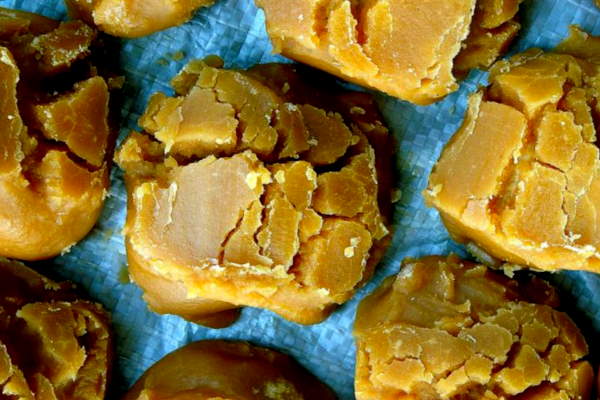
Jaggery is unrefined sugar made by boiling sugarcane juice or palm sap until it solidifies, without separating out the molasses. That is the whole difference from white sugar, which is refined and centrifuged to remove everything except sucrose. Keeping the molasses is why jaggery is brown, tastes of caramel, and retains some minerals.
Our sugar guide covers the general case, and Indian food has plenty that suits babies without needing sweetening.
Jaggery against white sugar
The minerals are real. Look at the proportions, though:
| Per 100 g | Jaggery | White sugar |
|---|---|---|
| Energy | 383 kcal | 387 kcal |
| Total sugars | Around 75 g | 100 g |
| Iron | 2 to 11 mg | 0 mg |
| Magnesium | 70 mg | 0 mg |
| Potassium | 1050 mg | 2 mg |
| Calcium | 80 mg | 1 mg |
Mineral content varies widely with the source and processing. A teaspoon is about 5 g, so the mineral amounts per serving are very small. Source: USDA FoodData Central.
When can children have jaggery?
The same timeline as any other added sugar:
No water, no jaggery water, no sugar water. Breast milk or formula supplies everything a baby needs at this stage, and sweet drinks displace it.
Fruit sweetens porridge, sweets and baking perfectly well. Mashed banana, date paste and apple puree all do the job with fibre attached.
Jaggery in a traditional sweet or stirred into a dish is fine occasionally. Keep it to mealtimes and follow with teeth brushing.
Jaggery water for newborns is not recommended: the practice of giving a newborn jaggery, sugar water or honey in the first days is traditional in several cultures, and health authorities advise against all of it. Newborns need only breast milk or formula. Honey specifically carries a serious botulism risk under 12 months, which our honey page covers.
Sweetening without it
All of these bring something more than sweetness:
Mashed banana
The simplest option, sweet and thick, and it works in porridge, baking and yogurt.
Date paste
Blended dates are intensely sweet and bring fibre and a little iron with them.
Apple or pear puree
Adds sweetness and moisture at once, especially useful in baking.
Cardamom and cinnamon
Neither contains sugar, and both make food taste sweeter than it is. Traditional and free.
Risks and safety
Jaggery is not dangerous, and a taste of a traditional sweet at a festival is nothing to worry about. The concerns are the ordinary ones attached to sugar: decay in newly erupted teeth, calories crowding out nutrient dense food in a small stomach, and a growing expectation that food should be sweet. The World Health Organization recommends limiting free sugars for everyone, and the first two years are the easiest time to keep them near zero.
One physical point worth noting. Jaggery is often sold in hard blocks or lumps, which are firm enough to be a choking hazard for a young child. If it is being used, grate or dissolve it rather than handing over a piece. Some jaggery is also produced with minimal processing controls, so buy from a reputable source.
Jaggery FAQ
Can babies eat jaggery?
Best avoided before 24 months. Jaggery is unrefined sugar made from cane juice or palm sap, and although it retains some iron and minerals that white sugar loses, it is still around 70 to 85 percent sugar. Added sugars are not recommended under two, and jaggery counts as one.
Is jaggery healthier than white sugar?
Slightly, and not enough to change the advice. Because it is unrefined, jaggery keeps small amounts of iron, magnesium and potassium that refining strips out. The quantities are small relative to the sugar, though, so it is better thought of as sugar with trace minerals than as a health food.
Should I give jaggery water to a newborn?
No. Giving jaggery water, sugar water or honey to a newborn is a traditional practice in several countries, and it is not recommended. Babies under 6 months need only breast milk or formula. Sugar water displaces milk, offers no nutrition, and honey specifically carries a botulism risk under 12 months.
Does jaggery help with iron deficiency?
Not meaningfully. Jaggery does contain iron, but you would need to eat a large amount to get a useful dose, and that amount of sugar would do more harm than the iron does good. Lentils, meat, fortified cereals and green vegetables are the sensible sources for a baby.
Sources
- Jaggery, Wikipedia.
- Healthy diet, World Health Organization.
- Foods and Drinks for 6 to 24 Month Olds, Centers for Disease Control and Prevention.
This article is general information, not medical advice. Every baby is different. Talk to your doctor, health visitor or paediatrician about your own baby, and about starting solids or any allergy concerns.