Can Babies Eat Durian?
Yes, from around 8 months, a small amount at a time. Durian has a fearsome reputation built almost entirely on its smell, which has nothing to do with whether a baby can eat it. It is a safe, nutritious fruit. The two things to know are that the seeds must come out, and that it is far richer than other fruit, so portions stay small.
Durian is famous for being banned from hotels and public transport across Southeast Asia because of the smell, which is genuinely powerful and which people either love or cannot tolerate. None of that bears on whether it suits a baby. Nutritionally it is a perfectly good fruit that happens to be unusually rich, and babies who grow up with it eat it happily.
What is durian?
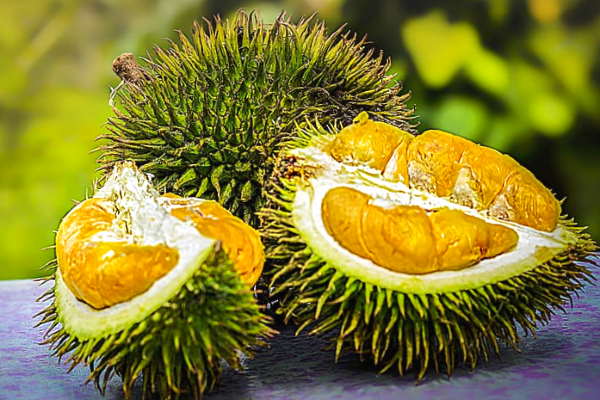
Durian is a large spiky tropical fruit from Southeast Asia, containing segments of soft custard like flesh around large seeds. The flavour is sweet and creamy with savoury and onion notes, which is why descriptions vary so wildly. It is unusual among fruits in containing a meaningful amount of fat.
If you want a similarly creamy tropical fruit that is gentler on a small stomach, mango and papaya both work from six months.
Durian nutrition
Compare the fat and sugar rows against banana to see why portions stay small:
| Per 100 g | Durian | Banana |
|---|---|---|
| Energy | 147 kcal | 89 kcal |
| Sugars | Around 20 g | 12 g |
| Fat | 5.3 g | 0.3 g |
| Fibre | 3.8 g | 2.6 g |
| Potassium | 436 mg | 358 mg |
| Vitamin C | 20 mg | 9 mg |
Typical values for raw durian flesh. Source: USDA FoodData Central.
Serving durian by age
Small portions throughout, since it is rich rather than risky:
Remove every seed, mash the flesh well and mix it with banana or yogurt to soften the richness. Start small and see how their stomach handles it.
Soft segments cut small enough to manage. The flesh is dense and can be sticky, so it is easier mixed into something than eaten alone.
No special restriction beyond keeping portions reasonable, given the sugar and fat content. The seeds still come out at every age, exactly as with jackfruit.
Every segment has a large seed: durian seeds are roughly the size of a chestnut, smooth and hard, and they sit inside the soft flesh where they are easy to overlook if you are scooping quickly. Separate the flesh from each seed by hand and check before it reaches a baby. Raw seeds should not be eaten at any age.
Durian and banana blend
Banana and yogurt cut through the richness and make the texture more manageable:
Durian and banana blend
Makes 2 small baby portions, from 8 monthsIngredients
- 2 tablespoons ripe durian flesh, seeds removed
- Half a ripe banana
- 2 tablespoons plain full fat yogurt
- A little water or milk to loosen
Method
- Remove the seed from each segment of durian flesh and check nothing hard remains.
- Mash the durian thoroughly, since the flesh is dense and custard like.
- Blend or mash with the banana and yogurt until smooth.
- Loosen with a little milk if stiff, and serve a small portion straight away.
Risks and safety
Durian allergy is rare, though it has been reported, so introduce it on its own as with any new food. The seeds are the clear physical hazard and must be removed every time, the same rule that applies to lychee stones.
The other consideration is simply richness. Durian carries considerably more sugar and fat than most fruit, and a large portion sits heavily on a small stomach, sometimes causing wind or loose stools. That is discomfort rather than danger, and starting with a teaspoon avoids it. Ripe durian also ferments quickly once opened, developing an alcoholic note, so eat it fresh and refrigerate any leftovers promptly rather than leaving it at room temperature.
Durian FAQ
Can babies eat durian?
Yes, from around 8 months, in small amounts with the seeds removed. Durian is nutritionally decent, providing potassium, vitamin C and B vitamins, but it is much higher in sugar and fat than most fruit, so a spoonful or two is plenty rather than a full portion.
Is durian too rich for a baby?
It is richer than most fruit, with roughly five times the fat of a banana and a high natural sugar content. That is not harmful, and the fat is useful energy for a baby, but a large portion can be heavy on a small stomach and may cause wind or a loose nappy. Start with a teaspoon.
Are durian seeds dangerous?
The seeds are a choking hazard and should always be removed, since they are large, smooth and hard. Raw seeds also contain compounds that are best destroyed by cooking, so they should not be eaten raw at any age. Boiled and mashed durian seeds are eaten in some cuisines and are fine for adults.
Does durian really combine badly with alcohol?
There is some evidence behind that piece of folklore, as compounds in durian appear to interfere with the enzyme that breaks down alcohol. It is not relevant to babies, who should not have alcohol at all, but it is a genuine interaction rather than pure superstition.
Sources
- Durian, Wikipedia.
- Choking Prevention, American Academy of Pediatrics.
- FoodData Central, U.S. Department of Agriculture.
This article is general information, not medical advice. Every baby is different. Talk to your doctor, health visitor or paediatrician about your own baby, and about starting solids or any allergy concerns.